
About
The only syndicate led by someone who spent twenty years as a customer.
Most GovTech investors have studied the market from the outside. We ran it from the inside, sitting across the table from the startups pitching us, signing the contracts, managing the relationships, and learning exactly why some companies earned the trust of government agencies and others never got past the first meeting. That experience is not a credential we mention in passing.
It is the reason our deal flow, due diligence, and post-investment support work differently from those of every other syndicate operating in this space.
WHAT WE INVEST IN
We back high-impact, high-moat businesses in two markets that most investors underestimate and almost none truly understand: GovTech, where the opportunity is to solve the deep structural inefficiencies in how governments manage data, security and digital services at scale, and Climate and Environmental Technology, where the opportunity is to build durable economic infrastructure on top of natural systems that are moving from the periphery of the economy to its centre. Both markets are driven by necessity rather than preference, both reward businesses that embed themselves early and deeply, and both require an investor who knows what they are looking at well before the broader market does.
We already know how this works.
The Australian government spends over $100 billion annually on procurement. Less than 2% of the software segment reaches local startups. The opportunity is structural and large, but it is also genuinely difficult to evaluate from the outside.
Most investors who look at GovTech apply the wrong benchmarks without realising it, discounting long sales cycles without understanding what drives them, mistaking a letter of support from an enthusiastic public servant for a buying signal, and modelling revenue against SaaS comparables that were never designed for a business with a government customer at the centre of its growth story.
Our team carries two decades of Commonwealth procurement experience across Defence, Home Affairs, Health and DFAT, which means that when we look at a deal, we already know what a real pipeline looks like in this market, what doesn't survive contact with a procurement panel, and where founders tend to overestimate how close they actually are to a contract.
By the time an opportunity reaches our syndicate, we've already stress-tested the go-to-market against how government actually buys, validated the regulatory and policy environment, and pressure-checked whether the founding team has the patience and political literacy to navigate a sales motion with no real equivalent in the private sector.
You're not being asked to take a view on a market you don't know. You're being asked to back our conviction in one we've spent our careers inside.
Before we invest, we screen every opportunity with four questions:
- Does this business solve a problem that governments or policymakers cannot ignore? Not a nice-to-have, not a productivity improvement that sits in someone's inbox for three years, but a genuine obligation that creates a durable mandate to act.
- Can it embed itself as infrastructure? Once it is established inside an agency or department, will it become the default rather than a vendor on rotation, and does the switching cost compound over time in the customer's favour as much as the founder's?
- Do the founders understand how to sell into a complex institutional market? Not just whether they have government contacts, but whether they have the patience, the political literacy, and the appetite to play a sales game that runs on a fundamentally different clock to anything in the private sector.
- Is the market large enough to sustain multi-year, high-value contracts at scale? Because the cost of winning in government is high, the business only makes sense if the prize is worth the effort of getting there.
DEAL FLOW: WHY WE SEE WHAT OTHERS MISS
Government procurement runs on rules, and most businesses treat that as the problem, spending their energy pushing against a system that was never going to bend for them rather than learning how to make it work in their favour. The teams that win in Formula 1 don't resent the regulations; they study them with more rigour than anyone else in the field, find every advantage the rules permit, and turn the constraints themselves into a competitive edge that their competitors can't easily replicate.
We spent the better part of two decades managing multi-billion-dollar government contracts and leading procurements across healthcare, transport, security and essential services, which gave us a view of the market that most investors and most founders simply don't have access to. We know how GovTech companies get entrenched inside agencies, how contracts are shaped long before they ever appear on a tender portal, and how the procurement rules that look like walls from the outside can be read as a roadmap by those who know what they're looking at.
The mental model we keep coming back to is this: government goes shopping when it's hungry, and it doesn't browse. When a genuine need arises, when policy creates an obligation, when a minister needs a solution and needs it to be defensible, the agency doesn't hesitate and doesn't run a wide market process for the sake of it. The companies that win those moments are the ones who were already in position, already trusted, already embedded in the conversation before the requirement was formalised. Most companies have no idea when that moment is coming or how to be standing in the right place when it does.
We back the ones who do, and we help the ones who are close get the rest of the way there.
Regenerative Deal Flow – Turning Nature into an Asset Class
The most compelling environmental investments are not those that cause the least harm. They are the ones that actively restore, generating compounding ecological and economic value over time, in the same way that a healthy reef system generates fisheries productivity or a restored wetland generates flood mitigation that an insurance actuary can price. The businesses we back in this space are not making sustainability claims; they are building economic infrastructure on top of natural systems that the world cannot afford to lose and is only beginning to understand how to value properly.
We back founders who are turning undervalued natural assets into durable economic engines, across marine biodiversity credits, ecosystem-backed financial instruments and nature-based infrastructure, because we believe the gap between the ecological value of these systems and the price the market currently assigns to them is one of the most significant mispricings in any asset class right now. The risk that most investors perceive in these markets is largely a function of unfamiliarity rather than fundamentals, and unfamiliarity is exactly the kind of barrier that rewards those who do the work to understand what they are actually looking at.
Regenerative industries do not scale the way software does, and the capital that suits them is not the capital that is chasing the next platform company. They require patient, multi-generational investment from people who understand that compounding here happens in ecological time as much as in financial time, and who are comfortable holding conviction across a cycle longer than most fund mandates were designed for. The shift toward a nature-backed economy is already underway and accelerating under the weight of regulatory pressure, corporate disclosure requirements and the plain physical reality of what happens when natural systems are not maintained.
The businesses that embed themselves in that transformation now, before the market fully prices its inevitability, are the ones we are looking for.

WHY WE INVEST IN GOVTECH & ENVIRONMENTAL MARKETS
On the surface, GovTech and environmental technology seem to have very little in common. One is about navigating procurement frameworks and ministerial priorities, and the other is about restoring ecosystems and managing the physical consequences of a climate that is no longer behaving predictably. But the investment thesis underlying both of them is identical, which is why we hold conviction in both rather than treating them as separate bets.
Both are what we think of as forever markets, meaning the demand driving them is consumer preferences, platform trends, or the enthusiasm of an early-adopter cohort. It is generated by necessity: by the obligation governments have to keep critical services running, by the regulatory and physical realities that are forcing organisations to manage environmental risk whether they want to or not, by the simple fact that infrastructure, resilience and sustainability are not things that any serious institution gets to treat as optional. The customers in these markets are not shopping around for a better experience. They are managing obligations they cannot defer.
That structural quality of demand produces a second consequence that matters enormously to us as investors: once a solution is adopted in either of these markets, the switching cost is genuinely high and often prohibitive. The businesses that secure these contracts don't become vendors in the conventional sense; they become part of the operating architecture of the organisations they serve, creating a durable revenue stream that is very difficult to replicate in markets where customers can simply choose something else next quarter.
We invest where markets are moving from optional to essential, and where the businesses that get there first have a structural advantage that compounds rather than erodes. Both of these markets are in that transition right now, which is precisely why we think the timing matters as much as the thesis.

THE PINERY CAPITAL ADVANTAGE
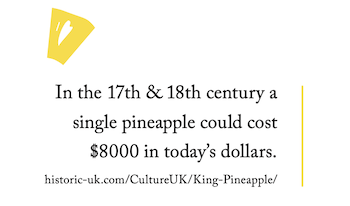
In seventeenth-century England, a pineapple cost the equivalent of eight thousand dollars in today's money, not because it tasted extraordinary, but because almost nobody could get one. The people who understood its value weren't responding to market price; they were reading scarcity, novelty, and cultural signals well before those qualities were reflected in any consensus. The fruit itself hadn't changed. What had changed was who was paying attention.
The name Pinery Capital comes from that idea, and so does the investment philosophy behind it. Real value in early-stage markets is rarely visible to everyone at once. It lives in the gap between what something is worth and what the market currently believes it is worth, and closing that gap requires a particular kind of knowledge: domain fluency deep enough to see what generalist investors miss, and the patience to hold conviction while the rest of the market catches up.
In GovTech and environmental markets, that gap is structural. The procurement cycles are long, the regulatory context is complex, and the customer relationships that determine who wins a contract are built over years rather than quarters, all of which means that the businesses creating genuine value in these markets are systematically underpriced by investors who lack the context to evaluate them properly. That is the opportunity we are built to see, and it is why access and expertise are not peripheral to what we do but central to it.
We invest where the value is already there, in markets where knowing what you are looking at is the edge.

Team
Mat Voller - Advisor, Investor, Startup Boards.
Mat spent 20 years in government, including 6 years in procurement, buying complex goods such as infrastructure, blood, technology, and services, and learnt the invisible rules that can determine which startups actually win government contracts.
Here's what most investors miss: In the US, one in four unicorns has government contracts. In Australia, we have one. Of the $3.2 billion Australian governments spent on technology in FY 24/25, startups captured just $52 million—not because their products are wrong, but because they fundamentally misunderstand how government actually buys.
That's the gap where Pinery Capital invests.
Mat backs operators who become the default capital source in markets traditional investors overlook: GovTech startups navigating 18-month sales cycles, regenerative aquaculture operators banks won't finance, and founders patient enough to build infrastructure rather than chase quick exits.
He also leads AQX, a debt-financing company that provides equipment capital to oyster, mussel, and seaweed farmers—delivering both financial returns and measurable ocean restoration. He sits on the Oceanfarmr board and mentors founders building in complex, overlooked markets.
Mat backs operators over opportunists. He writes Not on the Panel, where he teaches the $100+ billion secret inside Government.
His philosophy: Value isn't found—it's cultivated. Like the 17th-century Pinery builders who invested time and resources to grow their own pineapples instead of renting them for status, Mat backs founders who build greenhouses, not just display the fruit.